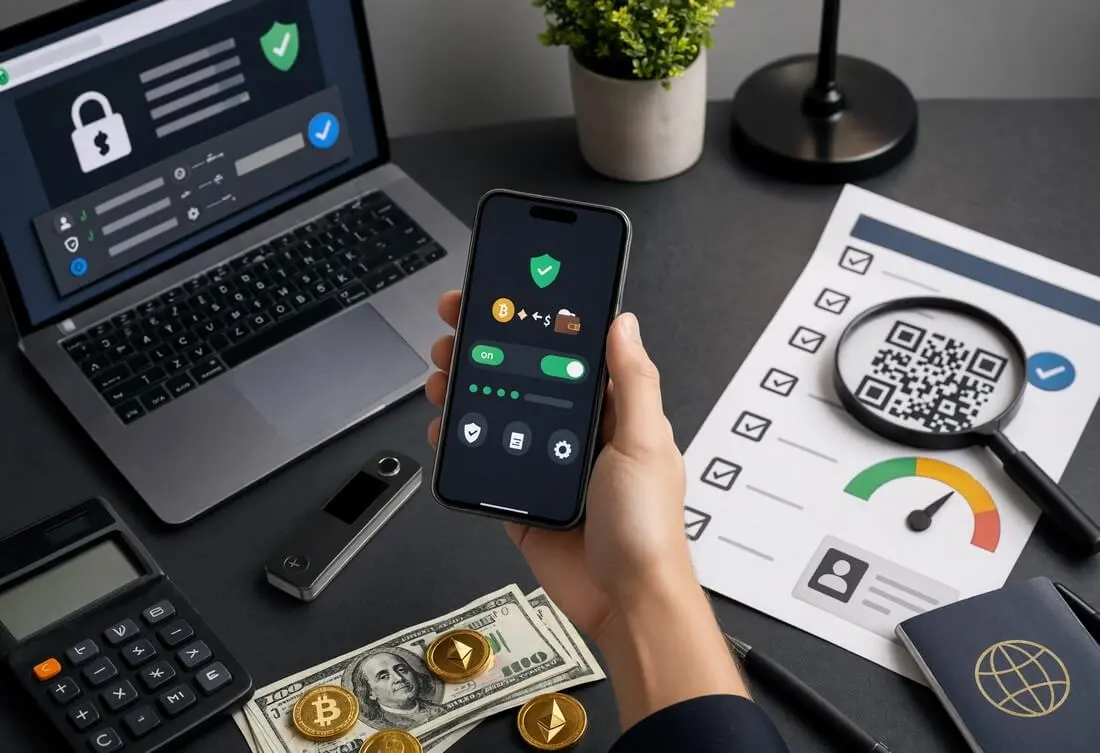
Many users choose a crypto exchanger by comparing only the rate. That is understandable. If one service gives more USDT for the same amount of fiat, the deal looks better. But in crypto, a small price advantage can hide a much larger risk: a fake website, a cloned brand, a third-party bank account, a manipulated quote, dirty crypto, a frozen withdrawal, or a support team that stops replying once the payment is made.
Why the cheapest rate is not the safest rate
A crypto swap is not just a price transaction. It is a trust transaction. You trust a website, a wallet address, a payment rail, a blockchain network, a liquidity source, and sometimes an unknown counterparty. If one part of that chain fails, the cheapest rate becomes irrelevant.
The most important question is not “Where can I get the best rate?” The first question is “Can I explain and document this transaction if something goes wrong?” A safe swap should be clear before payment: who receives the funds, what asset will be sent, on which network, at what rate, under which rules, with what fees, and what happens if the transaction is delayed or cancelled.
This guide is written for the English-speaking market, but the phrase “English-speaking market” does not mean one legal system. The United States, the United Kingdom, Canada, Australia, New Zealand, Singapore and offshore jurisdictions treat crypto services differently. Some exchanges may be registered in one country, restricted in another and unavailable in a third. This article does not replace local legal advice. It gives a practical due diligence framework for users who want to avoid obvious mistakes before using a crypto exchanger.
For broader background on transaction risk, InvestLB also has a guide on checking cryptocurrency before exchange and a separate article on crypto address risk indicators. The logic is universal: the asset, the address and the payment path matter as much as the visible rate.
What is a crypto exchanger?
A crypto exchanger is a service that helps users swap fiat money, stablecoins, cryptocurrencies or payment balances. A user may exchange USD, EUR, GBP or another fiat currency for USDT, BTC, ETH or another asset. The flow often looks simple: create an order, receive payment details, send funds, wait for confirmation and receive crypto to a wallet address.
This is different from a full crypto exchange. A centralized exchange normally provides user accounts, balances, trading pairs, order books, custody, KYC procedures, deposit and withdrawal histories, and sometimes regulated services depending on jurisdiction. A simple exchanger may not provide a trading account at all. It may only process one swap at a time.
It is also different from P2P trading. In P2P, you trade directly with another user while a platform provides an interface, ratings, chat and sometimes escrow. P2P risk is strongly tied to the counterparty: who sends fiat, whether the name matches, whether funds arrive from a third party, whether a later fraud complaint can affect your bank account. InvestLB has a separate guide on P2P deals and direct crypto trading risks.
A crypto exchanger sits somewhere between these models. It may be faster than an exchange and simpler than P2P, but the user still sends money or crypto first and waits for the other side. That waiting period is where due diligence matters.
Main risks before using an exchanger
The risks are not all technical. Some are legal, some operational, some related to fraud, and some related to compliance.
The most common risks are:
- A fake or cloned website that copies a real exchanger.
- A new scam website with no real liquidity.
- A domain that looks similar to a known service but has one changed letter.
- Payment details sent outside the order page.
- A bank account or card belonging to an unrelated third party.
- A crypto address that receives or sends funds connected to scams, hacks, mixers or sanctioned entities.
- A hidden spread, network fee or manual recalculation after payment.
- Wrong network selection, such as sending USDT on the wrong chain.
- No clear refund policy.
- Support that answers quickly before payment and disappears after payment.
- KYC demanded only after funds are sent, with no prior rule.
- Follow-up requests for “tax”, “verification”, “unlock fee” or “insurance”.
No checklist can remove every risk. But a checklist can prevent blind transfers. In crypto, that matters because many payments are not reversible. The FTC explains that cryptocurrency payments usually do not have the same legal protections as card payments and typically are not reversible once sent. That does not mean every crypto transaction is bad. It means the user must verify before paying, not after.
Regulatory reality: crypto services are not all equal
Crypto businesses operate in very different regulatory environments. Some are licensed or registered as virtual asset service providers, money services businesses, money transmitters, payment firms or cryptoasset firms. Others operate offshore, under weak supervision or without clear legal status.
FATF describes virtual assets as digital representations of value that can be digitally traded, transferred or used for payment. It also warns that virtual assets can be used by criminals when regulation is weak, and says virtual asset service providers should apply preventive measures such as customer due diligence, recordkeeping and suspicious transaction reporting.
For a user, the practical conclusion is simple: a serious exchanger should not advertise itself as a way to bypass all controls. If a service promises “no AML”, “no questions”, “any amount”, “no bank issues” or “anonymous swaps with guaranteed clearance”, that is not a safety feature. It is a risk signal.
In the United States, FinCEN guidance explains that businesses dealing with convertible virtual currency may have Bank Secrecy Act obligations depending on their model and facts. In the United Kingdom, the FCA tells consumers to check the Financial Services Register and warns that many crypto activities are not protected by the Financial Ombudsman Service or the Financial Services Compensation Scheme. These details vary by jurisdiction, but the direction is consistent: crypto services are increasingly expected to know customers, keep records and manage financial-crime risk.
How to think about jurisdiction
A crypto website can be written in English, serve users from many countries and still be legally based somewhere else. That matters. A user in the United States may care about FinCEN, state money-transmission rules, sanctions compliance and consumer reporting channels. A user in the United Kingdom may care about the FCA register, financial promotions rules and whether a firm is permitted to offer or promote crypto services. A user in Canada, Australia or Singapore may face different registration, tax and reporting rules.
Do not treat English-language support as proof that the service is appropriate for your country. Check:
- where the operator is incorporated;
- whether it restricts users from your country;
- whether the terms mention your jurisdiction;
- whether local regulators maintain a register or warning list;
- whether the service names a licensed or registered entity;
- whether the domain, company name and payment recipient match;
- whether customer support can explain which legal entity serves you.
If a service refuses to say who the legal operator is, where it is based or which rules apply, the user is left with very little leverage if something fails. That does not automatically mean fraud, but it does mean higher risk.
A realistic definition of a safer crypto exchanger
No exchanger can be called absolutely safe. A better question is whether the service has enough signs of operational reliability.
A safer exchanger usually has:
- A stable domain and no signs of cloning.
- Clear exchange rules before payment.
- A visible order number.
- A transparent rate, fee and final amount.
- Clear network selection.
- A stated refund policy.
- Support that answers specific questions.
- A history of reviews across more than one place.
- A reasonable reserve for the selected pair.
- No pressure to pay instantly.
- No demand for seed phrases, remote access or banking codes.
- A document trail: order, receipt, address, transaction hash and chat.
This is not a guarantee. It is a minimum standard. If several of these pieces are missing, the user should either reduce the amount, run a test transaction or walk away.
The commercial angle: where monetization can fit safely
For a publisher, this topic can support monetization without pushing readers into reckless choices. The safest commercial model is not “click here for the best rate at any cost.” It is a comparison or referral model built around due diligence: verified directions, clear disclaimers, transparent ranking logic and warnings about AML, KYC and third-party payments.
For an English-speaking audience, a useful commercial block can be framed as:
- compare exchangers by pair, network, limits and fees;
- check whether the service supports your country;
- check whether KYC may be required;
- check whether the service accepts your payment method;
- start with a test transaction;
- keep documents;
- never treat a referral link as a guarantee.
This matters for trust. Search engines and readers are more likely to value a page that helps users make a safer decision than a page that simply pushes the highest-paying partner. In crypto, the wrong recommendation can harm the reader quickly. A good article should make the reader slower, not more impulsive.
Step 1. Check the exact domain
Fake exchanger websites often work because users do not check the address carefully. A scammer can copy the interface, logo, colors and even support widget of a known service. The only visible difference may be a domain with a missing letter, extra dash, unusual top-level domain or hidden redirect.
Before entering payment details, check:
- the exact spelling of the domain;
- the top-level domain;
- whether the site was opened from an ad, social media message or search result;
- whether the domain is unusually new;
- whether the site redirects through short links;
- whether the browser shows certificate warnings;
- whether the official social profiles or monitoring pages point to the same domain;
- whether old bookmarks point to a different address.
HTTPS is not enough. Fraudulent domains can use HTTPS too. A lock icon means the connection is encrypted. It does not mean the business is legitimate.
The best practice is to bookmark verified services and use the bookmark later. Avoid searching the name every time and clicking the first sponsored result. Search ads are a common entry point for impersonation.
Step 2. Check the service history
A new service is not automatically fraudulent, but it deserves less trust. A service with no history, no external mentions, no clear operator and an unusually attractive rate should not receive a large first payment.
Look for:
- How long the domain has existed.
- Whether the brand name appears in independent discussions.
- Whether reviews span months or years.
- Whether complaints are repeated.
- Whether the service has changed names.
- Whether its contact details are stable.
- Whether the website text appears copied from another exchanger.
Scam exchangers often use a short-cycle model: launch a polished website, offer a better rate, collect deposits, stop replying, close the domain and relaunch under a new brand. Time in the market is not proof of honesty, but lack of history is a risk factor.
Step 3. Read the rules before you create an order
Many users skip the rules because they look boring. That is a mistake. The rules tell you what happens when the easy scenario breaks: underpayment, overpayment, expired order, wrong network, blockchain delay, bank hold, KYC request or refund.
A usable rule page should answer:
- when the rate is fixed;
- whether the rate is floating;
- how long the order is valid;
- what happens if payment arrives late;
- what happens if the user sends the wrong amount;
- how refunds are handled;
- whether refund fees apply;
- which networks are supported;
- when KYC may be requested;
- what happens if the user refuses KYC;
- what proof of payment is accepted;
- how long support normally takes.
If the rules are vague, missing or replaced by “contact support”, the user carries more risk. A legitimate support team is useful, but it should not be a substitute for written terms.
Step 4. Understand fixed and floating rates
Crypto prices move quickly. Exchangers use different rate models. A fixed-rate order may lock the rate for a limited time. A floating-rate order may calculate the final amount when payment is received or when the blockchain confirms.
Neither model is automatically bad. The problem is unclear pricing.
Before payment, verify:
- The amount you send.
- The amount you receive.
- The exchange rate.
- The network fee.
- The service fee.
- The time limit.
- Whether the amount can change after payment.
- What happens if confirmation is slow.
If the first screen shows one amount and the final screen changes it without explanation, stop. A small difference due to network fees may be normal if disclosed. A large unexplained difference is a red flag.
Step 5. Compare the rate with the market
The best rate is not always fake, but an extreme rate needs an explanation. If one exchanger is far better than every other service, ask why. It may be a promotional campaign, a low-liquidity pair, a temporary inventory need or a simple error. It may also be bait.
Compare:
- the mid-market price;
- rates on major exchanges;
- rates on other exchangers;
- network fees;
- fiat payment fees;
- the final amount after all deductions.
Never compare only the headline rate. Compare the final amount received. A service can advertise a good rate and then recover the spread through fees, delays, recalculation or a worse network.
Step 6. Check reserves, but do not overtrust them
Many exchangers show reserves for each direction. If you want to buy 25,000 USDT but the listed reserve is 4,000 USDT, the order either cannot be completed or requires manual handling. If the reserve is much larger, the service may be more convenient.
But reserves shown on a website are not the same as audited financial statements. The SEC warns investors not to overrely on “proof of reserves” type claims because they may be only a snapshot, may not show liabilities and may not provide the same assurance as an audit.
For an exchanger, the practical rule is this: reserves are useful operational information, not proof that your funds are safe. For a large swap, ask support to confirm availability before payment. If support says “pay first, we will find liquidity later”, that is not a good answer.
Step 7. Test support before payment
Support should be tested before the transaction, not after the problem.
Ask a simple question:
- When is the rate fixed?
- What happens if I send a slightly different amount?
- Do you accept third-party payments?
- Which network should I use for USDT?
- What happens if KYC is required and I refuse?
- Can I get an order confirmation?
- How do refunds work?
Good support answers the question directly. Bad support rushes you, sends unrelated templates, asks for payment immediately, avoids rules, moves you into a private messenger without order context or gives payment details manually outside the website.
Support quality is part of the product. If the service cannot answer basic questions before receiving money, do not expect better communication after a delay.
Step 8. Read reviews with skepticism
Reviews are useful, but they are easy to manipulate. A page full of short five-star comments is not enough. A single angry review is also not enough. You need patterns.
Look for:
- Review history over time.
- Specific order details.
- How the exchanger responds to complaints.
- Repeated problems: non-payment, delayed refunds, KYC after payment, third-party payments.
- Whether positive reviews sound natural or copied.
- Whether negative reviews are resolved.
- Whether reviews exist outside the exchanger’s own website.
The most valuable reviews are not “fast, great service.” They are detailed problem cases. A reliable service can have complaints. The difference is whether it explains, refunds, corrects errors and keeps a public record of resolution.
Step 9. Understand AML risk and dirty crypto
When you receive cryptocurrency, you do not only receive an amount. You receive transaction history. Some funds may be associated with ransomware, hacks, scams, darknet markets, mixers, sanctions exposure, stolen assets or high-risk services. Blockchain analytics tools and compliance teams may flag those histories.
This is why AML risk matters. If you later send the funds to a centralized exchange, the exchange may freeze the deposit or ask questions. If you sell the funds through P2P, your bank may ask about the source. If the incoming wallet has suspicious links, you may spend time proving that you are not connected to earlier activity.
Check:
- the sending address;
- the receiving address;
- the transaction hash;
- the network;
- whether the funds come from a known service;
- whether an AML screening tool shows high-risk categories;
- whether the exchanger can explain the source of liquidity for large orders.
InvestLB’s guide on crypto address risk indicators goes deeper into this issue. The short version is simple: a cheap swap is not cheap if the coins become difficult to use later.
Step 10. Verify the network before sending
USDT, USDC and many other assets exist on multiple networks. The same token symbol can move on Ethereum, TRON, BNB Chain, Polygon and other chains. Fees, addresses and confirmation rules differ.
Before sending, verify:
- Asset ticker.
- Network.
- Address.
- Memo, tag or destination tag if required.
- Minimum deposit amount.
- Network fee.
- Number of confirmations required.
- Whether the exchanger supports that exact network.
Do not type wallet addresses manually. Copy them and check the first and last characters after pasting. Clipboard malware can replace addresses. QR codes should also be checked after scanning.
If the site does not clearly show the network, do not send. “USDT” alone is not enough information.
Step 11. Verify payment details
Fiat payment details should match the order flow. If a support agent sends a different bank account or card in a private chat, risk increases sharply.
Check:
- the amount;
- the payment method;
- the recipient name, where visible;
- whether the recipient is a business or an individual;
- whether the name matches the service;
- whether the payment reference is required;
- whether the order page and chat show the same details;
- whether payment is requested in several parts;
- whether the service asks for a false payment description.
A false payment description is a serious warning sign. If the exchanger asks you to write “gift”, “loan repayment”, “rent”, “family transfer” or another inaccurate description, it is not protecting you. It is creating a misleading record that may hurt you later.

Third-party payments are a major red flag
A third-party payment is when the person sending or receiving fiat is not the real party to the swap. In P2P and semi-manual exchange flows, this can create serious banking and fraud risk.
Third-party payments can lead to:
- bank fraud complaints;
- frozen accounts;
- reversal attempts;
- inability to explain the transaction;
- connection to a scam victim;
- involvement with money mules;
- compliance review by a platform or bank.
If the exchanger says “any card is fine” or “someone else will pay you”, be careful. Convenience is not the same as safety. InvestLB has already covered P2P deals and direct crypto trading risks. The same logic applies to many exchanger flows: banks look at the transaction pattern, not only the user’s intention.
KYC is not always bad, but it must be predictable
Many users dislike KYC. That is understandable. Identity checks create friction and privacy concerns. But in regulated or semi-regulated crypto services, KYC can be part of legitimate risk management, especially for large amounts, unusual flows or high-risk wallets.
The issue is not whether KYC exists. The issue is whether it is disclosed and handled properly.
Check:
- when KYC may be required;
- what documents are requested;
- who processes the data;
- how personal data is stored;
- what happens if KYC is refused;
- whether funds are returned if the swap cannot continue;
- whether the privacy policy is credible;
- whether documents are uploaded through a secure interface.
A suspicious KYC request may ask for unrelated documents, full card photos, online banking access, screen sharing, seed phrases, SMS codes or remote-control software. None of that is normal for identity verification.
What a legitimate exchanger should never ask for
Some requests are unacceptable regardless of the reason.
Do not provide:
- seed phrase;
- private key;
- wallet recovery phrase;
- SMS codes;
- push confirmation codes;
- online banking password;
- remote access to your device;
- screen sharing while logged into a bank;
- full card number with CVV unless you are using a legitimate card payment page;
- a new crypto payment to “unlock” a previous crypto payment.
If a service needs a private key or seed phrase to “verify” your wallet, it is trying to steal the wallet. If it needs a second payment to release the first one, the risk of fraud is extremely high.
Warning signs of a scam exchanger
Scam signals often appear together.
Watch for:
- A rate far better than the market.
- A new domain with no history.
- No rules or vague rules.
- No clear refund policy.
- Support pressure.
- Payment details sent only in chat.
- Requests to pay an individual unrelated to the service.
- False payment descriptions.
- “No AML checks ever” as a selling point.
- “No bank issues guaranteed.”
- Claims of full anonymity for any amount.
- Copied reviews.
- No negative reviews anywhere.
- Additional fees after payment.
- A required tax, insurance or unlocking fee.
- Requests for remote access or wallet recovery data.
- A “manager” moving the conversation to a private messenger.
- Threats that funds will be lost unless you pay more.
If you see several of these signs, stop. A legitimate exchanger may have fees, rules and checks. A scammer has urgency, secrecy and new payments.
Why “anonymous and no questions” can be dangerous
Privacy matters, but “no questions for any amount” is not a reliable promise. It can attract stolen funds, scam proceeds and mule activity. If a service builds its brand around avoiding every compliance question, honest users may receive assets or fiat flows that create problems later.
A safer service has predictable rules. It tells users what it supports, what it refuses, when verification may happen and how refunds work. That is less exciting than “instant anonymous swaps”, but it is more useful when something goes wrong.
Check the refund policy before you need it
Refund rules are rarely exciting. They become important when:
- the order expires;
- the user sends the wrong amount;
- the user pays late;
- KYC is requested;
- the user refuses KYC;
- the network is wrong;
- the bank payment is delayed;
- the exchanger cannot complete the order;
- AML screening flags the deposit.
A good refund policy states timeframes, fees, destination of refund and conditions. A bad policy says only “at the administration’s discretion.”
Be especially careful if a service asks for a new payment to process a refund. Normal refund costs should be disclosed and deducted transparently, not requested as a separate surprise payment.
How to handle large swaps
Do not send a large first transaction to a new exchanger. Even if the service looks legitimate, run a smaller test.
A safer process:
- Check the domain.
- Read the rules.
- Ask support a real question.
- Confirm reserves.
- Run a small test swap.
- Check the received asset.
- Save all documents.
- Increase the amount only if the test is clean.
A test transaction is not a guarantee. A scam service can process small orders and steal larger ones. But the test still reveals basic problems: bad support, unclear fees, wrong network handling, no order history or poor documentation.
How to document the transaction
Documentation protects you if a bank, exchange, tax adviser, lawyer or law-enforcement officer asks what happened.
Keep:
- order number;
- date and time;
- exchange pair;
- quoted rate;
- final amount;
- payment receipt;
- wallet address;
- transaction hash;
- network;
- support chat;
- AML screening result, if available;
- refund communication, if any;
- screenshots of the order status.
Name files clearly. A folder called “crypto swap” is less useful than “2026-06-23_USDT_TRON_to_USD_order_12345”. Good documentation does not make a risky transaction safe, but it makes later explanations possible.
What to do if an order is delayed
A delayed order is not always fraud. Blockchain congestion, insufficient confirmations, underpayment, wrong reference codes and manual checks can cause delays. The response should be calm and documented.
Steps:
- Do not create a second identical order.
- Save the order number.
- Check the bank payment status or blockchain transaction hash.
- Take screenshots.
- Contact support through the official website.
- Ask for a written explanation.
- Ask for a timeframe.
- If the explanation changes repeatedly, record each answer.
- If fraud signs appear, contact your bank, wallet provider, exchange and law enforcement where appropriate.
Do not pay an extra “release fee” simply because support says the order is stuck. A legitimate network fee should be visible before payment or explained through rules. A surprise unlocking fee is a common scam pattern.
What to do if you sent to the wrong network
Wrong-network transfers are one of the most painful crypto errors. Recovery depends on technical control of the receiving address and the policies of the service. Sometimes recovery is possible. Sometimes it is not.
If it happens:
- Stop sending more funds.
- Save the transaction hash.
- Record the network, asset, address and amount.
- Contact support immediately.
- Ask whether the service controls the receiving address on that network.
- Ask whether recovery is possible and what the fee is.
- Do not trust outsiders who promise guaranteed recovery.
No third-party “recovery expert” needs your seed phrase. If they ask for it, they are not recovering the transaction. They are taking the wallet.
Cash exchange adds physical risk
Some crypto exchangers offer cash deals. This adds a different risk layer: personal safety, counterfeit notes, surveillance, meeting location, couriers, robbery and lack of records.
For cash swaps:
- use an office or safe public location;
- avoid last-minute location changes;
- do not go alone for large amounts;
- confirm the rate before meeting;
- verify the identity of the courier or office;
- count and check cash before releasing crypto;
- keep written records;
- do not discuss large amounts publicly;
- do not accept pressure to move to a car, hallway or private apartment.
If a service offers a large cash exchange through an unnamed courier with no paperwork, the risk is high even if the rate is good.
Bank transfer and card payment risks
When fiat moves through a bank, the bank sees transaction patterns. It may review unusual transfers, frequent incoming payments, third-party payments, rapid movement of funds, inconsistent payment descriptions or activity that does not match the user’s normal profile.
To reduce risk:
- Do not use someone else’s bank account.
- Do not accept payments from unrelated third parties.
- Do not write false payment descriptions.
- Do not split payments artificially.
- Keep the order and receipt.
- Be able to explain the source of funds.
- Avoid regular business-like turnover through a personal account without proper setup.
If a bank later asks questions, the user should be able to show the order, receipt, transaction hash and reason for the exchange. Silence and inconsistent explanations make things worse.
Do not confuse an exchanger with an investment platform
Many scams begin as “simple exchange help” and then become fake investing. A person helps you buy crypto, sends you to a professional-looking dashboard, shows fake profits and then demands more money to withdraw.
An exchanger should perform a defined swap. It should not pressure you into:
- managed trading;
- guaranteed returns;
- copy trading with a stranger;
- a secret arbitrage strategy;
- an account that requires “tax” before withdrawal;
- a “VIP plan”;
- a deposit bonus;
- a broker manager who controls your funds.
The FTC warns that investment scams often promise large returns with little or no risk, use fake websites and block withdrawals unless more fees are paid. If a swap turns into an investment pitch, stop and verify the business as an investment firm, not only as an exchanger. InvestLB has a separate guide on checking brokers and investment projects.
Recovery scammers target victims again
If you lose money to a fake exchanger, you may be targeted again by “recovery agents.” They may claim they can reverse blockchain transactions, unlock frozen funds, recover a wallet, negotiate with a regulator or trace stolen crypto for a fee.
Be careful if they:
- guarantee recovery;
- ask for upfront crypto payment;
- ask for a seed phrase;
- ask for remote access;
- claim to be from a regulator but use free email or messenger;
- say you must pay tax or insurance to release funds;
- tell you not to contact your bank or law enforcement.
Real professionals can help document the case, prepare reports, contact platforms or advise on legal options. They cannot magically reverse a blockchain transaction by receiving another payment.
When to report a scam
If you believe the exchanger is fraudulent, report quickly and preserve evidence.
Depending on your country and situation, you may report to:
- your bank or card issuer;
- the exchange or wallet used to send funds;
- the FTC in the United States;
- the FBI IC3 for internet crime in the United States;
- the SEC or CFTC if securities, commodities or derivatives issues are involved;
- the FCA in the United Kingdom;
- local police or cybercrime authorities;
- the platform where you found the ad or profile.
The FTC lists several places to report cryptocurrency scams, including ReportFraud.ftc.gov, the CFTC, the SEC, IC3 and the crypto exchange company used to send money. Reporting does not guarantee recovery, but it creates a record and may help connect addresses, accounts and domains to a wider scheme.
Practical pre-order checklist
Before creating an order, check:
- Exact domain.
- No suspicious redirects.
- Service history.
- External reviews.
- Written rules.
- Final rate and fees.
- Supported network.
- Refund policy.
- KYC policy.
- Reserve for the pair.
- Support responsiveness.
- No unrealistic promises.
If three or more items are unclear, do not send a large amount.
Practical payment checklist
Before sending fiat or crypto:
- Save the order number.
- Confirm the amount.
- Confirm the network.
- Confirm the wallet address.
- Confirm memo/tag if required.
- Confirm recipient details.
- Confirm payment reference.
- Check that the order timer has not expired.
- Check that payment details match the website.
- Refuse false payment descriptions.
- Refuse third-party payment requests.
- Take a screenshot before payment.
This checklist takes minutes. It can prevent a permanent mistake.
Practical post-swap checklist
After completion:
- Save the payment receipt.
- Save the transaction hash.
- Save the order status.
- Save the wallet address.
- Save the support chat.
- Check the amount received.
- Check the network.
- Run AML screening for larger sums.
- Store documents in a clear folder.
- Do not delete the account or chat immediately.
If the swap becomes relevant later, you will not need to reconstruct it from memory.
FAQ
Is any crypto exchanger completely safe?
No. A crypto exchanger can be more or less reliable, but no service removes all technical, legal, AML and counterparty risk. The goal is risk reduction, not certainty.
Is a better exchange rate a sign of a better service?
Not by itself. A better rate is useful only after the domain, rules, reserves, support, reviews, network and payment details have been checked. An extreme rate can be bait.
Does HTTPS prove the exchanger is real?
No. HTTPS only means the connection is encrypted. A fake website can also have HTTPS. Always check the exact domain and the source of the link.
Should I use an exchanger that promises no KYC ever?
Be careful. For small amounts, limited checks may be normal depending on the service and jurisdiction. But “no questions for any amount” is a risk signal because legitimate services often need to manage AML and fraud risk.
Is proof of reserves enough?
No. Reserve information can help show operational capacity, but it is not the same as an audit and does not automatically prove solvency or safety. The SEC warns that proof-of-reserves style claims may be limited snapshots and may not show the full liability picture.
What is dirty crypto?
It is a practical term for crypto that has links to high-risk sources such as hacks, scams, ransomware, mixers, sanctioned wallets or darknet markets. Different tools may score risk differently, but poor transaction history can cause problems when you later deposit or sell the asset.
Can a blockchain transaction be reversed?
Usually no. Once confirmed, a crypto transaction normally cannot be reversed by a bank or card issuer. Recovery depends on the recipient, platform control, law enforcement action or special technical circumstances.
Should I accept fiat from a third party?
Usually no. Third-party payments create fraud, banking and documentation risk. The payer should normally match the transaction party or be clearly documented under the service’s rules.
What if support asks for my seed phrase?
Stop immediately. A seed phrase or private key gives control over the wallet. A legitimate exchanger does not need it to process a swap.
What if I already sent money to a fake exchanger?
Save all evidence, stop sending additional payments, contact your bank or wallet provider, report the scam to relevant authorities and avoid recovery agents who demand upfront fees or wallet access.
Final thoughts
Checking a crypto exchanger is not about finding a perfect service. Perfect services do not exist. It is about refusing to send money when the risk is already visible. A good rate is useful only if the transaction path is clear, documented and technically correct.
Before sending funds, check the domain, history, rules, rate, reserves, support, reviews, AML risk, payment details and network. If the service pressures you, hides rules, changes payment details manually or demands extra fees after payment, stop. In crypto, a pause before payment is often worth more than the fee you were trying to save.
The safest swap is the one you can explain before it happens: what you are exchanging, why, through whom, on which network, at what rate, with what proof and under what refund rules. If you cannot explain it before payment, do not expect it to become clearer after your funds are gone.
Official sources and useful materials
- FATF: Virtual Assets
- FTC: What To Know About Cryptocurrency and Scams
- SEC Investor Alert: Exercise Caution with Crypto Asset Securities
- FCA: Crypto investment scams
- FinCEN Guidance on Convertible Virtual Currencies
- InvestLB: Checking cryptocurrency before exchange
- InvestLB: Crypto address risk indicators
- InvestLB: P2P trading and risks
- InvestLB: 2FA authentication
- InvestLB: How to check a broker and investment project
Publication author