
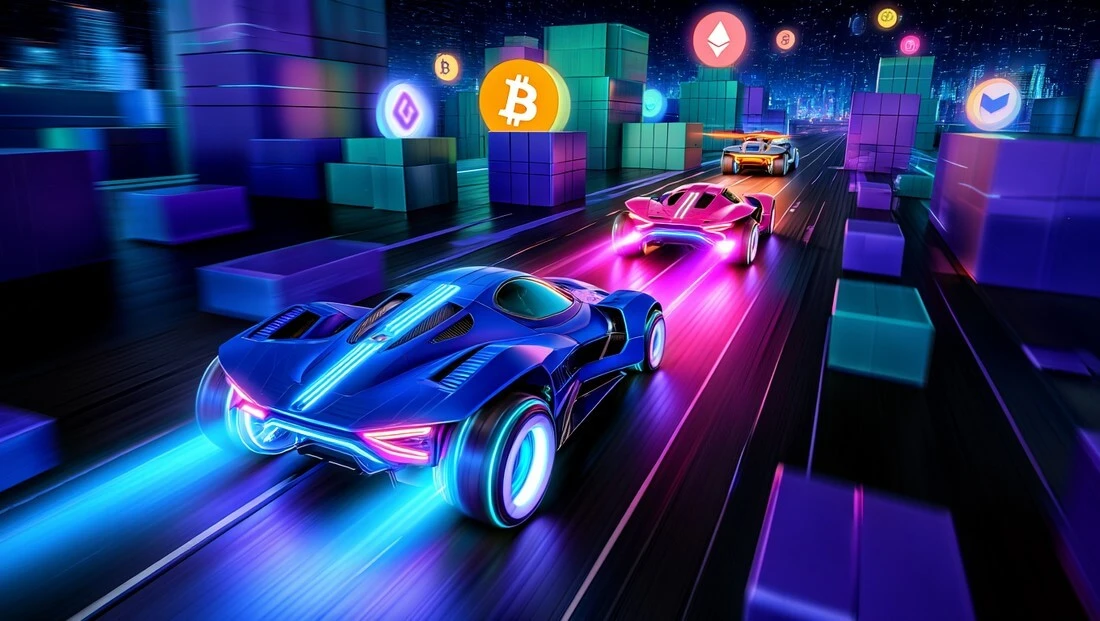
The gaming industry has long ceased to be just entertainment. In 2026, crypto games have already formed a separate segment of the market, where players earn not only for victories, character progression, and completing tasks, but also for participation in the project’s economy: trading NFTs, staking tokens, in‑game tournaments, and owning rare items. For some, this is a way to monetize gaming time; for others, it is an opportunity to enter the Web3 ecosystem through a familiar and intuitive format.
In this article, we will look at how crypto games work in the Play‑to‑Earn model, what sets them apart from ordinary blockchain projects, which mechanics actually bring income, and why in 2026 you should treat them not as a way to easy money, but as a full‑fledged digital market with its own risks, rules, and economics.
What crypto games are
Crypto games are video games whose internal economy is built on blockchain. Most often, such projects use:
- an in‑game native token;
- NFT items, characters, equipment, or cards;
- a marketplace for trading in‑game assets;
- a reward system for participation, victories, or asset ownership.
The main difference from traditional games is that items and tokens here can have external market value. The player does not receive only digital value inside the game, but an asset that can be exchanged for cryptocurrency and then cashed out to fiat via an exchange or a wallet.
At the same time, it is important to understand: not every blockchain game is a stable source of income. In many projects, the token price depends on player activity, demand for items, overall liquidity, and the state of the crypto market. Therefore, the Play‑to‑Earn model should be treated as an economic system, not as a guaranteed income.
Why crypto games became popular
The rise in interest in crypto games is tied to several factors at once.
First, players gained the ability to monetize what used to be just a hobby. In a traditional game, you spend time leveling up a character or collecting rare items; in a blockchain game, these actions can bring tokens or NFTs.
Second, crypto games became a convenient entry point into Web3. A user who previously had no interest in DeFi, wallets, tokens, and blockchain can start familiarizing themselves with all of this through a game.
Third, many projects succeeded in combining high‑quality gameplay with the economics of digital assets. This is what distinguishes serious projects from one‑off tap‑to‑earn apps and questionable games where earnings are supported only by new participants.
How Play‑to‑Earn works
The Play‑to‑Earn model means that players receive rewards for activity in the game. This may include:
- completing tasks;
- taking part in battles or matches;
- passing missions;
- winning tournaments;
- mining items;
- trading NFTs;
- staking tokens;
- participating in project governance.
In practice, the system is usually built around three elements:
- Gameplay. The user plays, performs actions, and participates in the economy.
- Blockchain assets. For progress, tokens or NFTs are rewarded.
- Market. Assets can be sold, exchanged, or used further within the ecosystem.
Yet the model has weak points as well. Income depends on the token price, the balance of supply and demand, and the project’s own rules. If developers change the mechanics or the economy, the player’s profitability may drop sharply.
Axie Infinity: one of the first major crypto games
Axie Infinity is one of the most well‑known Play‑to‑Earn projects and one of the title holders that set the genre standard. The game is built around teams of Axie characters that battle other users and complete tasks.
Players receive two main types of rewards:
- SLP — for wins and in‑game activity;
- AXS — for participation in governance and staking.
Both tokens are traded on exchanges, meaning they can be converted into real money. This made Axie Infinity iconic: the game showed that a digital asset could become part of real‑world economics, not just an in‑game mechanic.
Axie Infinity’s strength lies in its recognition and established ecosystem. Its downside is high dependence on the balance of the economy and players’ interest. Yet as an example of an early mature crypto game, the project remains extremely important.
Gods Unchained: a card game with NFT cards
Gods Unchained is a collectible card game often compared with Hearthstone, but built on NFT and the Ethereum blockchain. In the game, cards exist as non‑fungible tokens, meaning they can not only be used in battles, but also sold on an internal marketplace.
Players receive:
- new cards for ranked matches;
- the GODS token;
- the ability to trade NFT cards for GODS or ETH.
This is a key example of how monetization can be built organically. The user does not have to do separate “token farming”; they simply play card matches, improve their collection, and at the same time accumulate assets.
Gods Unchained is especially interesting because it combines a familiar card‑game mechanic with full digital ownership.
Illuvium: an RPG with high‑quality graphics
Illuvium is an open‑world RPG with turn‑based combat that stands out for its high‑quality graphics and sound. Unlike many early blockchain games, Illuvium tries to look like a full‑fledged AAA‑style project, not an experiment for crypto enthusiasts only.
Players hunt creatures called Illuvials. These creatures exist as NFTs, so they can be traded on the internal marketplace. The main project token is ILV.
Illuvium’s advantages:
- strong visual quality;
- full‑featured RPG mechanics;
- linkage between in‑game progress and NFT economy;
- trading creatures and items on the internal market.
Such projects show where the segment is headed: not simply “a game for a token,” but a game where blockchain is built into the world’s structure and the value of items.
Big Time: dungeon‑crawling action with NFT items
Big Time is a multiplayer action RPG with dungeon‑crawler elements. The game is available via its own launcher on PC and is built around exploring dungeons, fighting bosses, and obtaining in‑game items.
Earnings inside the project are tied to:
- in‑game items;
- the BIGTIME token;
- NFT assets that can be sold on the project’s marketplace.
Big Time is interesting because it gives players economic participation not only via the token, but also via rare items. This is a key point: in such games, NFT items often become the core of the economy, not just the in‑game currency.
The project suits those who enjoy active gameplay, combat, and looting. For players, this means income depends not on passive waiting, but on actual participation in the game.
Shrapnel: a tactical shooter with an economy of items
Shrapnel is a tactical shooter in the spirit of Escape from Tarkov. The project attracted attention not only for its genre, but also for large investments—about 57 million dollars. This makes it one of the notable representatives of the new wave of crypto games.
The game model is built on raids, equipment farming, and crafting items. Players can:

- earn gear in raids;
- craft and sell in‑game items as NFTs;
- use the SHRAP token for transactions within the ecosystem.
In spring 2026, the game went into early access on Steam, which greatly increased its visibility. This is especially important: a Steam launch means the project reaches beyond the narrow Web3 audience and tries to compete in the mainstream PC‑gaming market.
Shrapnel is a strong example of how crypto games are becoming closer to mass‑market gaming and are no longer perceived as a niche only for crypto users.
Phantom Galaxies: a space action game with NFT spaceships
Phantom Galaxies is a space action game with transforming mechs, available on PC via Steam. The game combines space combat, action, NFTs, and a tokenized economy.
Players earn:
- ships and equipment as NFTs;
- tokens tied to the game’s ecosystem;
- assets that can be sold on the internal marketplace.
The game’s native token is ASTRAFER, and its blockchain base is Polygon. This combination makes Phantom Galaxies interesting from an infrastructure standpoint: the project uses a popular network with low fees suitable for an economy where players frequently trade items.
Phantom Galaxies shows that crypto games can be not only card‑based or RPG‑style, but also large‑scale sci‑fi projects with full‑blown combat.
What players actually earn in crypto games
To avoid the illusion of easy money, it is important to clearly separate the main sources of income.
Tokens
The most obvious way is token rewards for:
- wins;
- completing tasks;
- taking part in tournaments;
- participation in staking or governance.
The token’s advantage is that it can be exchanged on an exchange. The downside is that its price can be unstable.
NFT items
The second source of income is the trade in NFTs:
- characters;
- cards;
- weapons;
- armor;
- ships;
- rare items.
If an item is rare and in demand, it can be worth more than daily token rewards.
Tournaments and events
Many crypto games run tournaments, seasonal events, and challenges. Prize pools are often paid in tokens, NFTs, or rare in‑game assets.
Staking and ecosystem participation
In some projects, you can not only play, but also:
- hold tokens;
- participate in governance;
- earn extra rewards for long‑term involvement.
This is closer to an investment model than to pure gaming.
Risks of crypto games
Crypto games look attractive, but come with major risks.
Token volatility
If the project’s token price drops, the player’s income also drops. Conversely, even with high in‑game activity, users can earn less due to a market downturn.
Changes to the project’s economy
Developers can change the balance, rewards, fees, trade conditions, or the issuance of new items. This directly affects profitability.
Low NFT liquidity
Not every item is easy to sell. Sometimes NFTs exist, but there are no buyers.
High entry barrier
Some games require:
- buying starter assets;
- learning time;
- persistent participation;
- understanding of blockchain wallets and exchanges.
Overhyped expectations
Many users enter crypto games expecting quick earnings. In practice, they are often game economies with monetization potential, not a replacement for work.
How to choose crypto games
From a pragmatic point of view, choose projects based on several criteria:
- gameplay quality;
- economic transparency;
- token liquidity;
- existence of an active marketplace;
- audience and in‑game online presence;
- integration with Steam, Epic Games Store, or a custom launcher;
- development team stability;
- a clear, understandable roadmap.
A good crypto game should be enjoyable even without earning. If the only point of a game is a token promise with no real gameplay, its value usually drops quickly.
Why crypto games are noticeable again in 2026
By 2026, the market has moved out of the early stage. Earlier, many projects looked too raw, and their economy was built on hype alone. Now the situation is changing:
- graphics and sound have improved;
- games are launching on Steam and Epic Games Store;
- developers focus on actual gameplay;
- economies are built around NFTs and tokens, yet no longer look like pure speculation.
This makes crypto games closer to the traditional gaming industry. And this is why they are once again in focus for players, and investors.
What players should keep in mind
In short, crypto games are not a magical way to “play and print money.” They are a mix of:
- gameplay;
- digital ownership;
- blockchain economy;
- market risk.
In good projects, users get not only the chance to earn, but also real enjoyment from the game. In weak ones, they see only tokenomics without engaging gameplay.
So the correct approach is simple:
- treat the game as a product;
- evaluate the economy separately;
- avoid entering on emotion;
- understand volatility risks;
- do not confuse Play‑to‑Earn with guaranteed income.
Conclusion
In 2026, crypto games are no longer exotic but a separate segment of the gaming industry. Play‑to‑Earn projects allow earning tokens, NFTs, and in‑game items, but success depends not only on luck, but also on the game’s quality, demand for assets, and the stability of the economy.
Axie Infinity, Gods Unchained, Illuvium, Big Time, Shrapnel, and Phantom Galaxies show that the segment has diversified: from card battles to shooters and space action. This means players have a choice—to look not only for income, but also for formats they genuinely enjoy.
If viewed realistically, the best crypto game is not the one that promises the highest payouts, but the one you want to play even without rewards. This is what makes the crypto‑game segment promising in the long run.
Publication author


